
Overview
This use case converts geopolitical and conflict data into a structured regional risk assessment focused on Ukraine and neighbouring countries. The model combines historical conflict signals with country-level indicators to produce a forward-looking view of military and geopolitical risk over a multi-year horizon. Its purpose is not to predict a single deterministic event, but to rank countries by relative exposure and identify where conflict-related risk is concentrated.
For companies, investors and strategic-intelligence teams, this type of model provides a quantitative layer for decisions that are normally dominated by qualitative judgement. It can support country-risk monitoring, supply-chain planning, investment screening, insurance exposure reviews and scenario design by translating a complex geopolitical environment into comparable risk scores.
Business relevance
- Rank countries by projected conflict and military risk over a defined horizon.
- Identify where geopolitical exposure is concentrated around an active conflict zone.
- Support country-risk limits, investment screening and supply-chain contingency planning.
- Create quantitative triggers for escalation, scenario analysis and management review.
- Provide an interpretable complement to qualitative geopolitical intelligence.
Solution
The solution is to use the projected risk score as a prioritisation layer for geopolitical decision-making. Figure 1 shows a very clear concentration of risk in Ukraine, with a projected five-year score of roughly 16, while Hungary, Romania and Moldova remain materially lower, around 2.5, 2.2 and 1.7 respectively. The model therefore distinguishes the direct conflict centre from neighbouring markets that face spillover risk but not the same level of projected military exposure.
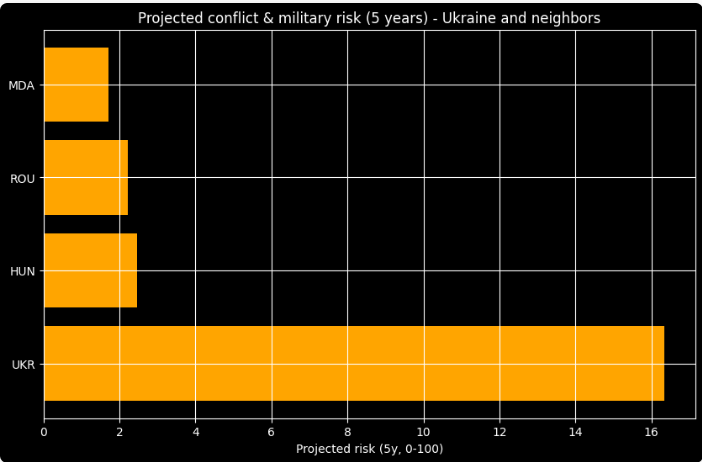
That ranking can be translated directly into different operating responses. Exposure linked to Ukraine should receive the strongest controls: tighter investment limits, more severe downside scenarios, contingency planning for logistics and personnel, and more frequent monitoring. Neighbouring countries can remain investable or operationally viable, but should be monitored for second-order effects such as border disruption, refugee flows, energy shocks, sanctions or regional escalation.
The chart therefore turns a geopolitical assessment into a decision framework. Rather than treating the whole region as equally risky, management can allocate attention and capital according to the relative score, define escalation thresholds and rerun the model as new information arrives. The value of the model is not only the number itself, but the ability to compare countries consistently and detect when a neighbouring market begins to move closer to the conflict-risk profile of the primary war zone.