
Overview
This use case builds a complete actuarial reserving workflow from reported and paid claims development data. It transforms historical claim triangles into age-to-age development factors, cumulative development factors (CDFs), ultimate claim estimates and reserves by origin year. The deterministic Chain Ladder estimate is complemented by the Mack framework to quantify prediction error and identify where reserve uncertainty is concentrated.
The workflow is designed for insurance portfolios where claims are still developing and the final cost is not yet fully observed. Rather than treating the latest paid amount as the final liability, the model estimates how much additional development remains. This allows actuarial teams to convert incomplete claims information into a structured estimate of ultimate losses, reserve requirements and model risk.
Business relevance
- Estimate ultimate claims and outstanding reserves from incomplete claims development.
- Identify which origin years still contain the greatest reserve requirement.
- Quantify uncertainty through Mack MSEP rather than relying on a single point estimate.
- Test how sensitive reserves are to development-factor and tail assumptions.
- Support actuarial closing, capital planning, solvency analysis and management reporting.
Solution
Solution
The solution is to use the Chain Ladder workflow as an automated reserving engine that converts historical claims development into an estimate of the insurer's remaining liability. Figure 1 provides the core development mechanics. The age-to-age link ratios show how paid claims typically grow from one development period to the next. The largest factor is concentrated in the early 12–24 month interval, while subsequent factors move progressively toward 1.0. This indicates that most claim development occurs early and that the amount of additional expected development declines as claims mature. These ratios are the basis for the cumulative development factors used to project incomplete origin years to ultimate.
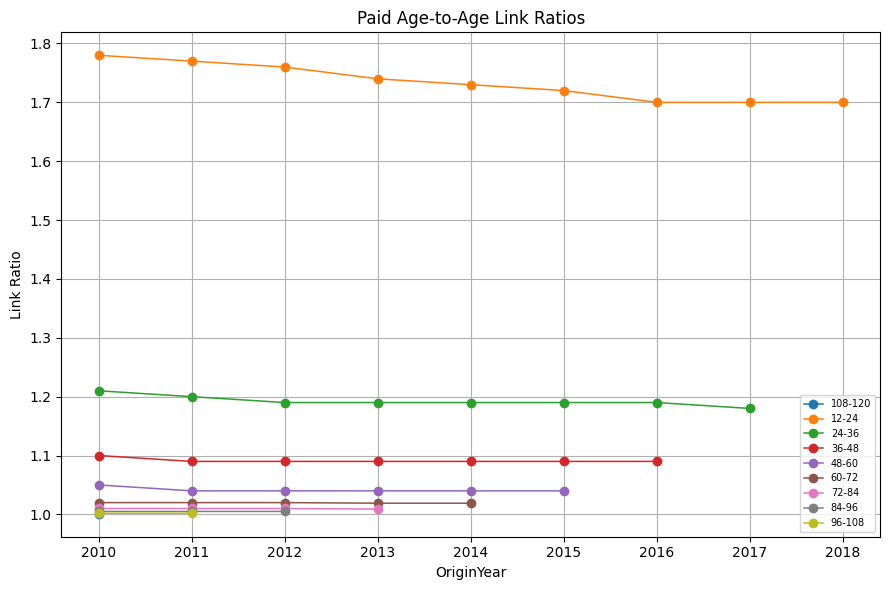
Figure 2 converts those development patterns into a management-level result. For mature origin years, observed and ultimate claims are almost identical, because little development remains. For the most recent years, the gap becomes much larger: the observed paid amount represents only part of the expected final cost. The widening difference is therefore the reserve requirement generated by the model. In the underlying case, the Chain Ladder calculation produces total projected ultimate paid claims of approximately 58,083 versus approximately 50,585 of latest observed paid claims, implying a total reserve of about 7,498.
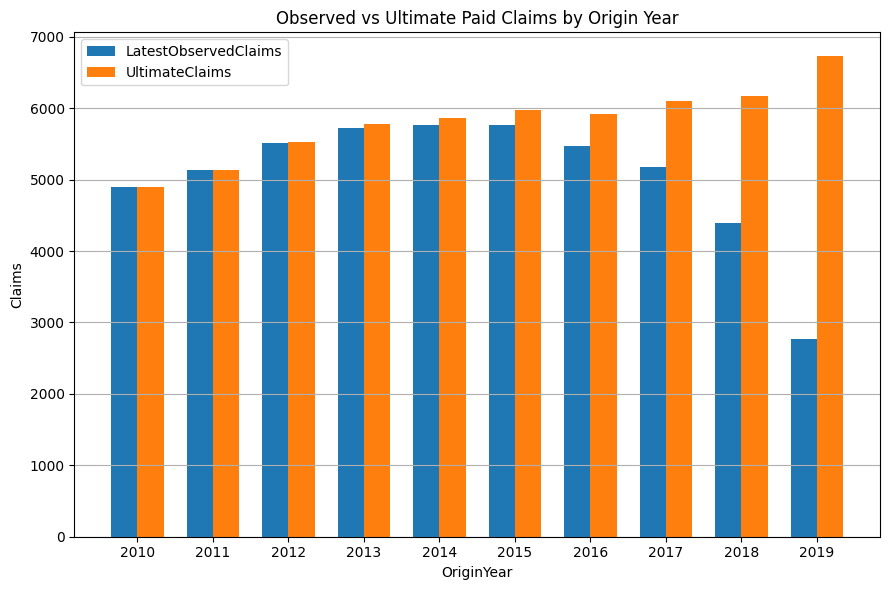
Used together, the two graphics provide both explanation and action. Figure 1 explains why a reserve is required by showing the historical development pattern; Figure 2 shows where that reserve is required and its economic magnitude by origin year. The Mack extension then adds MSEP and uncertainty ratios so actuarial teams can distinguish between a large reserve and an uncertain reserve. This creates a stronger basis for reserve adequacy reviews, capital allocation, solvency assessment, sensitivity testing and escalation of the origin years that deserve the most actuarial attention.