
Overview
This use case estimates the final cost of insurance claims that are still developing. It starts from historical incremental reported-claims triangles and uses age-to-age development factors to project incomplete accident or origin years toward their expected ultimate value. The key problem is simple: the most recent years contain only partial information, so the amount currently reported cannot be treated as the final loss.
By learning how older claims developed from one period to the next, the model derives a structured pattern of claim maturation. Those development patterns can then be applied to less mature cohorts to estimate how much additional loss is still expected to emerge. The result is a transparent actuarial framework for turning incomplete claims observations into ultimate-loss and reserve estimates.
Business relevance
- Estimate the final cost of claims before all payments and reports have emerged.
- Convert incomplete claims triangles into reserve and ultimate-loss estimates.
- Identify which development periods contribute most to claim growth.
- Support reserve adequacy reviews, actuarial closing and financial reporting.
- Provide an interpretable basis for management decisions instead of relying on raw reported claims.
Solution
Solution
The solution is to use the historical claims triangle as the empirical basis for estimating how incomplete claims will mature. Figure 1 makes the reserving problem visible. Older origin years contain observations across many development periods, whereas the newest years form the incomplete upper-right section of the triangle. That missing area is exactly the future claims development that the insurer needs to estimate. The darker values in the earliest development periods also show that a large share of reported loss emerges early, while later periods generally contain smaller incremental amounts.
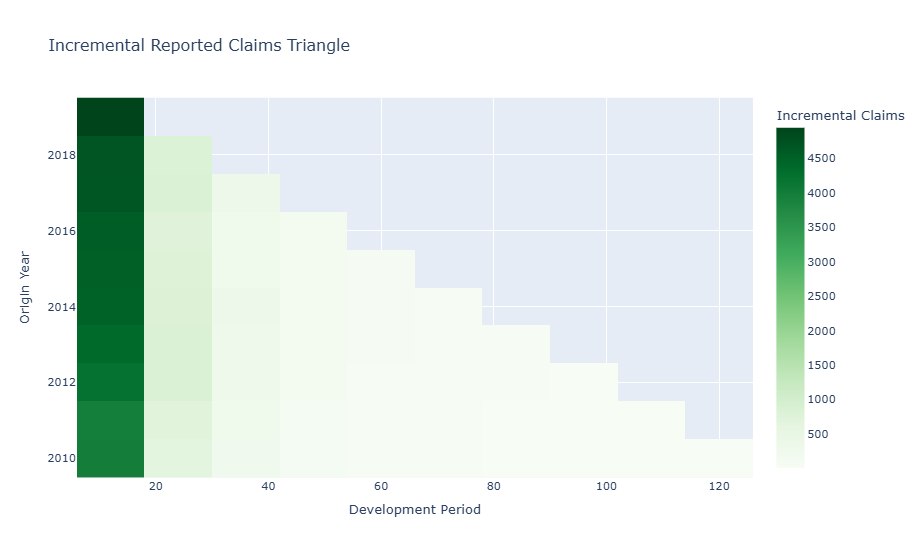
Figure 2 extracts the development pattern needed to fill that missing area. The selected age-to-age factor is highest in the earliest transition, at roughly 1.18, then falls rapidly toward 1.00 as claims mature. In practical terms, an immature claim cohort still has meaningful expected growth, while a mature cohort requires very little additional uplift. The model applies these factors sequentially to incomplete origin years to project their current reported values to an expected ultimate amount.
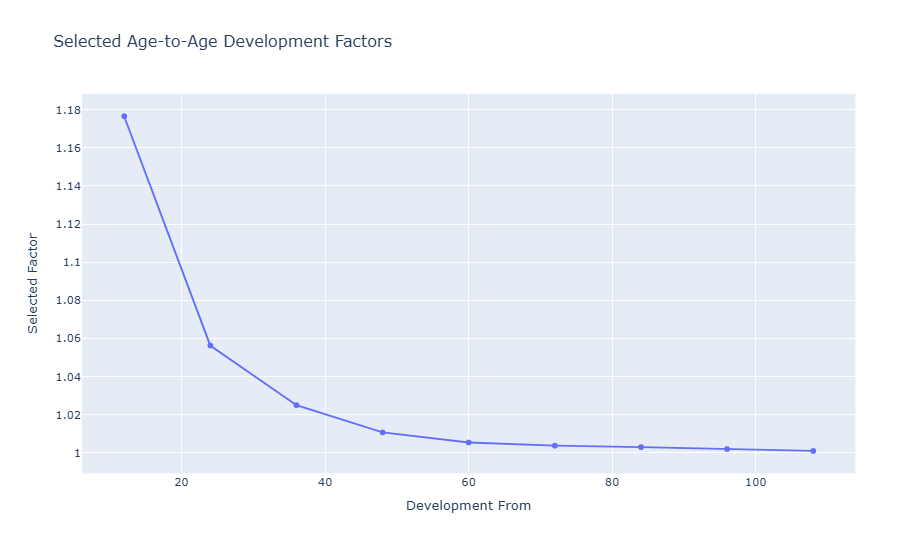
Together, the two graphics provide the full decision logic. Figure 1 shows which parts of the portfolio are incomplete and therefore require reserving; Figure 2 shows how much additional development should be expected at each maturity stage. This allows actuarial teams to estimate ultimate claims consistently, calculate outstanding reserves, identify the cohorts with the greatest remaining uncertainty and explain to management why recent origin years need materially larger reserve adjustments than mature years.