
Overview
This use case analyses General Wrong-Way Risk (WWR) in counterparty credit risk, focusing on situations where market exposure and counterparty credit quality deteriorate at the same time. The workflow combines Monte Carlo simulation with stressed scenarios to estimate Potential Future Exposure (PFE) and identify counterparties whose risk increases disproportionately when adverse market conditions occur.
WWR is especially important because ordinary exposure models may understate risk when they assume that market movements and counterparty default risk are independent. In practice, the same shock that increases the value of a derivative exposure can also weaken the counterparty. The model therefore compares baseline Monte Carlo PFE with stressed PFE across different tenors and counterparties.
Business relevance
- Detect counterparties whose exposure increases under the same conditions that weaken their credit quality.
- Compare normal Monte Carlo exposure with stressed PFE across multiple tenors.
- Prioritise counterparties where long-dated exposure becomes materially more severe under stress.
- Support collateral, limits, hedging and counterparty concentration decisions.
- Improve CCR stress testing by explicitly capturing dependence between market and credit risk.
Solution
The solution is to use the gap between Monte Carlo PFE and stressed PFE as a direct indicator of Wrong-Way Risk. Figure 1 shows how exposure changes across 1D, 1W, 1Y and 3Y tenors for the five highest-risk counterparties. The most important signal is not simply the largest absolute exposure, but where stressed PFE rises above the baseline Monte Carlo estimate. Those divergences indicate that adverse market conditions are amplifying counterparty exposure.
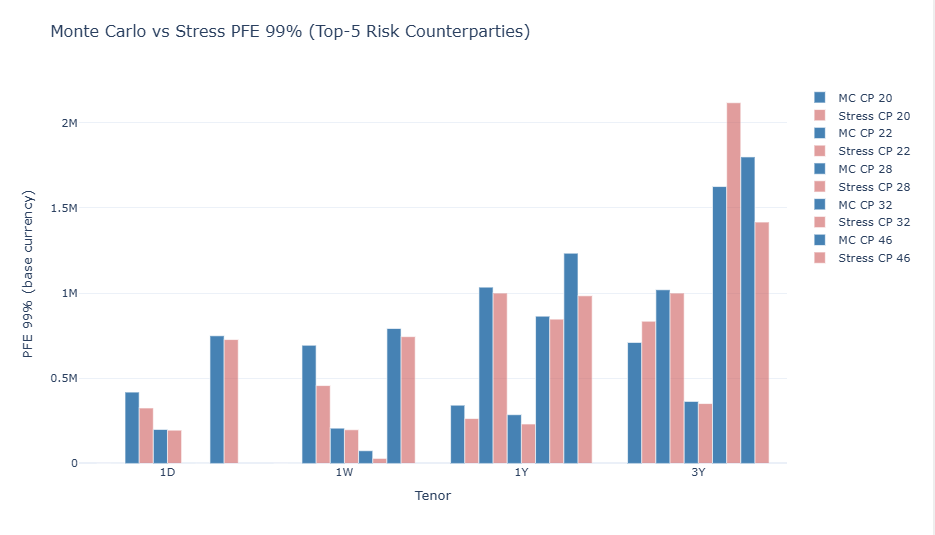
The chart also shows that WWR becomes more material at longer tenors. At 3Y, several counterparties exhibit exposures around or above one million in base currency, with one stressed counterparty exceeding roughly 2.1 million. That makes the long-dated part of the portfolio the main area for management attention, because a larger future exposure is being combined with a deterioration scenario rather than occurring independently.
Operationally, the bank can rank counterparties by the stressed-minus-baseline PFE gap, tighten limits where that gap is largest, require additional collateral, shorten maturity, reduce concentration or hedge the relevant market factor. The graph therefore turns WWR from a qualitative concern into a measurable exposure-control framework that can be embedded into CCR limits, stress testing and XVA governance.