
Overview
This use case applies the Merton structural credit-risk framework to estimate a company's probability of default from market and balance-sheet information. The model treats the firm's equity as an option on its underlying asset value and combines observed equity value, debt, interest rates and equity volatility to infer the firm's asset risk, Distance to Default (DD) and an implied probability of default (PD).
Unlike a purely accounting-based score, the Merton approach reacts to changes in market value and volatility. This makes it useful as a forward-looking credit-risk signal for corporate lending, bond portfolios and counterparty monitoring, particularly when market information begins to deteriorate before conventional financial statements fully reflect the change.
Business relevance
- Estimate market-implied corporate default risk from equity value, leverage, rates and volatility.
- Convert market movements into an interpretable Distance to Default and probability of default.
- Provide an early-warning signal that can react faster than periodic accounting information.
- Support corporate lending, bond surveillance, counterparty limits and credit-risk monitoring.
- Track how changes in equity value or volatility alter the firm's distance from the default boundary.
Solution
The solution is to use the Merton model as a market-sensitive early-warning layer around traditional corporate credit analysis. Figure 1 shows the full chain from observable inputs to the final risk signal. For each date, the model combines roughly EUR 25 million of equity, EUR 40 million of debt, a market rate around 3% and equity volatility near 46% to calculate a Distance to Default of about 2.64-2.65 standard deviations. That distance is then converted into an implied PD of approximately 0.40%-0.42%.
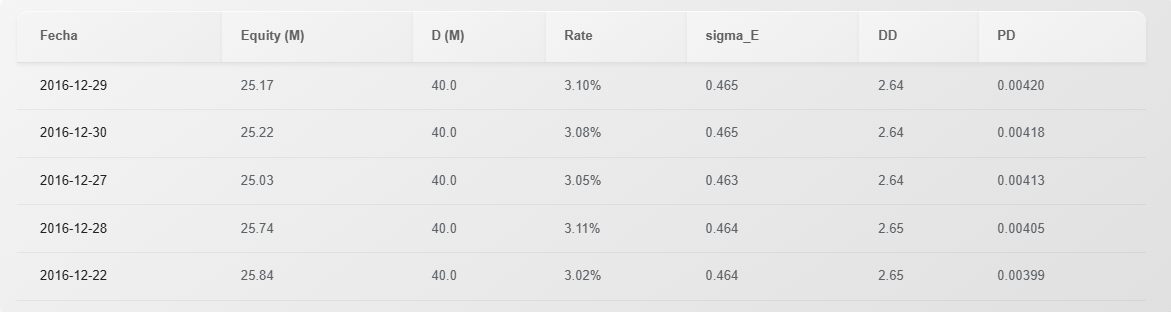
The key management variable is not any single input in isolation but how they interact. If equity value falls, leverage rises or equity volatility increases, the inferred asset value moves closer to the debt boundary, DD declines and PD rises. Conversely, stronger equity value or lower volatility increases the cushion between the firm's assets and its default point. The table therefore gives credit teams a compact explanation of why the market-implied risk estimate changes from one day to the next.
Operationally, the lender or investor can monitor DD and PD through time and define escalation thresholds. A persistent decline in DD or rise in PD can trigger a deeper borrower review, tighter limits, repricing, hedging or additional collateral requirements. This turns the Merton framework into a continuous credit-surveillance tool that complements financial ratios with information embedded in market prices.