
Overview
This use case analyses how corporate credit ratings migrate from one state to another over time using empirical transition probability matrices. Instead of treating a borrower's current rating as static, the workflow estimates the probability that an issuer remains in the same rating bucket, is upgraded, is downgraded, moves into default, or becomes unrated over the next period.
Transition matrices are a core building block in portfolio credit risk because they translate historical rating behaviour into a forward-looking distribution of possible states. They can be used to estimate expected credit deterioration, stress rating migration under adverse scenarios, project portfolio quality and provide inputs for default forecasting, economic capital, valuation and risk-limit setting.
Business relevance
- Estimate upgrade, downgrade and default probabilities from observed rating history.
- Identify which rating categories are stable and which are more vulnerable to deterioration.
- Project the future credit-quality distribution of a corporate portfolio.
- Support credit portfolio stress testing, economic capital and concentration analysis.
- Provide a transparent basis for early-warning triggers and migration-sensitive risk limits.
Solution
The solution is to use the transition matrix as a forward-looking credit migration engine. Figure 1 shows, for every starting rating on the vertical axis, the probability of moving to each possible rating state on the horizontal axis. The strong diagonal concentrations indicate that most issuers remain near their current rating over a one-period horizon, while the off-diagonal cells quantify the probability of upgrades and downgrades.
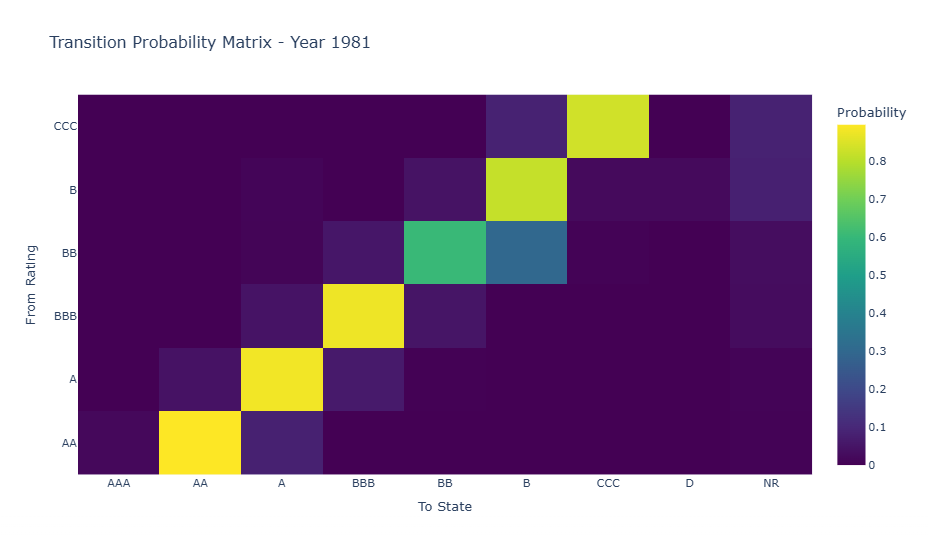
The matrix also makes asymmetry in credit deterioration visible. Higher-quality ratings tend to show high persistence, whereas weaker ratings display a broader distribution of possible next states and a greater probability of moving toward lower-quality categories or default. Rather than assigning a single deterministic future rating to each borrower, the model therefore produces a full probability distribution over possible credit states.
That distribution can be translated directly into portfolio decisions. A bank or asset manager can multiply current exposures by migration probabilities to estimate how much of the book may move into weaker rating bands, identify names that are likely to cross internal risk thresholds, estimate migration-driven losses and run adverse scenarios by shifting probability mass toward downgrades and default. In this way, Figure 1 becomes more than a historical summary: it is the core input for forward-looking credit-quality forecasting, early-warning monitoring and migration-sensitive capital allocation.