
Overview
This use case examines whether a credit-scoring model produces materially different outcomes across demographic groups and shows how those differences should be analysed before the model is used in lending decisions. The objective is not simply to maximise predictive performance, but to verify that the scorecard does not embed avoidable or unjustified disparities into approval, pricing or limit-setting decisions.
The workflow compares observed bad rates across groups, separates raw portfolio differences from potential model-driven bias and provides a governance framework for deciding whether sensitive or proxy variables should be retained, transformed, constrained or excluded. This makes the analysis relevant for fair-lending controls, model validation and responsible AI governance in retail credit.
Business relevance
- Detect whether borrower groups experience materially different observed credit outcomes.
- Separate genuine risk differences from disparities that may be introduced or amplified by the model.
- Support fair-lending reviews and model-risk governance before a scorecard is deployed.
- Provide an auditable justification for retaining, transforming or removing variables that may act as demographic proxies.
- Reduce regulatory, conduct and reputational risk without abandoning predictive credit-risk modelling.
Solution
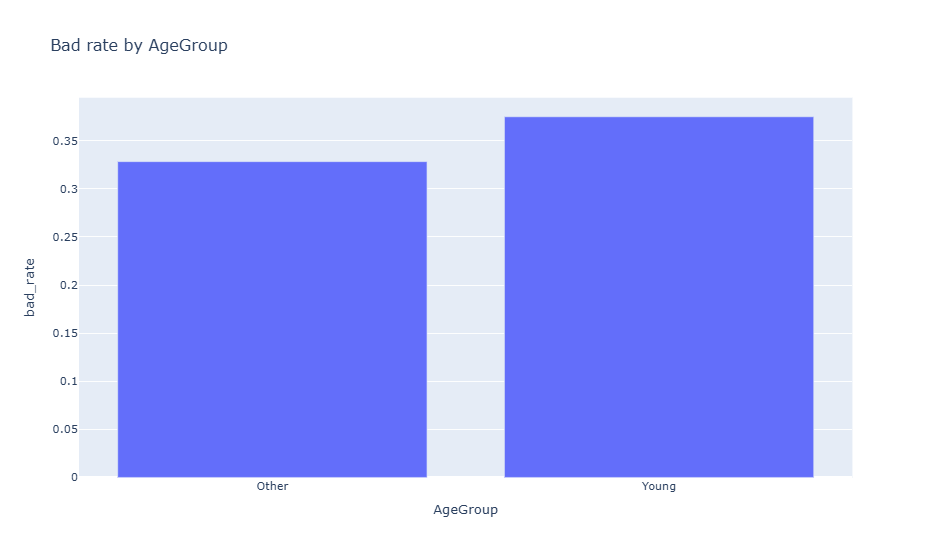
The solution is to use group-level outcome analysis as a mandatory fairness checkpoint around the credit-scoring model. Figure 1 shows that the observed bad rate is higher for the 'Young' group than for the 'Other' group, at roughly 37% versus 33%. That difference is economically visible, but the chart alone does not prove that the model is biased: it may reflect underlying portfolio composition, borrower characteristics, sampling effects or a genuine difference in observed default behaviour.
The correct response is therefore not to force both groups to have identical predicted risk. Instead, the lender should test whether the scorecard systematically over- or under-predicts risk for either group, compare approval and error rates at the chosen cut-off, inspect whether non-sensitive variables act as proxies for age, and confirm that any remaining disparity is explainable by legitimate credit-risk factors rather than by the protected characteristic itself.
The graph becomes the trigger for that governance process. If calibration and error-rate tests show that the model treats both groups consistently after controlling for legitimate risk drivers, the observed difference can be documented rather than artificially removed. If the model amplifies the gap or relies heavily on proxy variables, the relevant features or binning rules can be redesigned and the model revalidated. This turns fairness from a vague principle into a measurable credit-risk control linked directly to observable portfolio outcomes.