Overview
This case turns expert culinary practice into a quantitative optimisation problem. It studies whole-animal roasting—specifically suckling pig, with Peking duck as a computational comparison—using a reduced-order physics model that simulates heat transfer, moisture transport and browning-related reaction pathways across skin, fat and muscle layers. Approximately 5,000 roasting schedules are screened and compared through multi-objective Pareto analysis, with the key culinary trade-offs defined around crispness, juiciness and internal-heating progression. The framework then links the computational outputs back to expert-chef evaluation, showing how mathematical modelling can formalise and explain the type of compromise decisions that high-level chefs make in practice.
The key insight is that great roasting is not a single-objective maximisation problem. Surface crispness and internal juiciness are structurally in tension, because the surface must become hot and dry while the interior should remain moist. The model therefore does not look for one universally best schedule; instead, it maps the achievable frontier of trade-offs and shows that the chef-designed roast occupies a strong compromise region rather than an extreme point. In that sense, the case is an excellent example of Proxima Alpha’s broader philosophy: use rigorous modelling to make expert judgment more explicit, more reproducible and more transferable.
Business relevance
- Translate tacit expert knowledge into an explicit decision framework that can be analysed, stress-tested and reused.
- Optimise processes with structurally competing objectives rather than assuming that one metric can be maximised in isolation.
- Use reduced-order physics models to screen thousands of candidate operating schedules at very low experimental cost.
- Support R&D and product/process design in food, consumer goods and other sectors where transport and reaction dynamics matter.
- Connect simulation outputs to human sensory or expert evaluation, creating a bridge between quantitative modelling and real-world judgement.
Solution
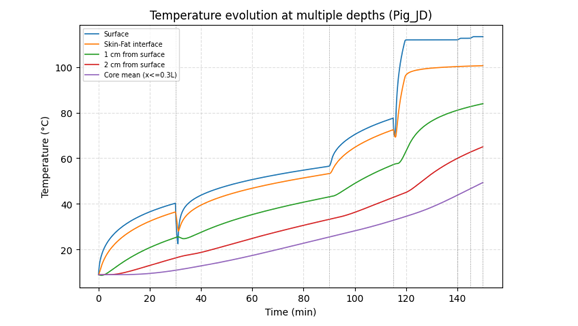
The solution architecture is powerful because it combines mechanism, optimisation and validation. First, the roast is represented as a layered system of skin, fat and muscle, allowing the model to simulate temperature and moisture trajectories through time and depth. Figure 1 captures one of the core physical findings: the outside of the animal heats and dries much faster than the interior, while the fat layer acts as a thermal and moisture buffer. This decoupling is what makes it possible—within limits—to form a crisp surface without immediately destroying interior juiciness. It also explains why roasting is inherently a balancing problem and why schedule design matters so much.
Second, the framework translates physical outputs into culinary objectives. Crispness is linked to browning plus surface dehydration, juiciness to retained muscle moisture, and internal-heating progression to how efficiently the core approaches a culinary reference temperature. These objectives are then evaluated across roughly 5,000 sampled schedules, and Pareto analysis identifies non-dominated candidates. The study shows that crispness and juiciness trade off structurally: schedules that push hardest for one tend to give up the other. That is exactly the kind of setting in which multi-objective optimisation adds value, because it reveals the efficient frontier rather than hiding trade-offs behind a single arbitrary score.
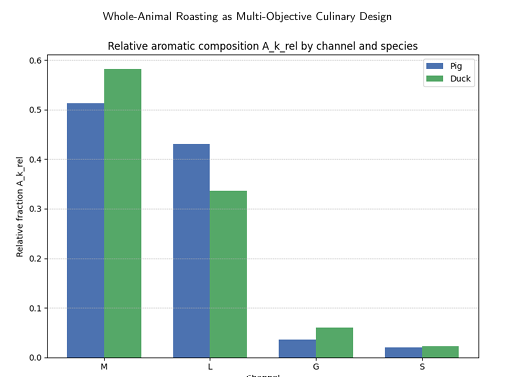
Third, the framework connects the model back to expert practice. A panel of 10 expert chefs evaluated 17 roasting schedules across crispness, juiciness and overall quality, and the aggregated panel showed extremely high reliability. The paper reports significant association between computational metrics and sensory scores, and the chef-designed schedule appears as a non-dominated compromise solution rather than a naive extreme. Figure 2 complements this by showing how aroma-related channels differ across species, adding interpretability to the flavour side of the model. Operationally, this kind of workflow could be reused for process design in culinary R&D, industrial food production, or any physical system where expert craftsmanship can be reframed as constrained optimisation under competing quality objectives.