
Proxima Alpha
What are the potential outcomes of a military intervention by the U.S. in response to Iranian retaliation following Israeli airstrikes on nuclear facilities in June 2025, using Monte Carlo simulations to assess the probability of escalation into a multi-front conflict involving Israel, Iran, and U.S. forces?
17-Sep-2025 14:33:46Executive Summary:
A Monte Carlo simulation was conducted to assess the probability of conflict escalation following the June 2025 Israeli airstrikes on Iranian nuclear facilities, Iran's retaliatory missile attacks, and the subsequent U.S. military intervention. The key question was to estimate the chances of the conflict expanding into a multi-front war involving Israel, Iran, and U.S. forces versus remaining bilateral or de-escalating.
Simulation Description:
- The model incorporated verified military capabilities from June 2025 for Israel, Iran, and the U.S., including troop numbers, aircraft, and missile inventories.
- Conflict events modeled included Israeli strikes on Iran's nuclear sites, Iran's missile and drone retaliations, and U.S. airstrikes (Operation Midnight Hammer).
- Uncertainty and escalation dynamics, such as the success of Israeli defense systems and the probability of U.S. intervention, were represented stochastically.
- The simulation ran 10,000 Monte Carlo iterations to generate probabilistic outcomes.
- Probabilities were computed for four outcomes: multi-front conflict, bilateral Israel-Iran conflict, limited U.S. conflict, and de-escalation.
Results (Probabilities of Each Outcome):
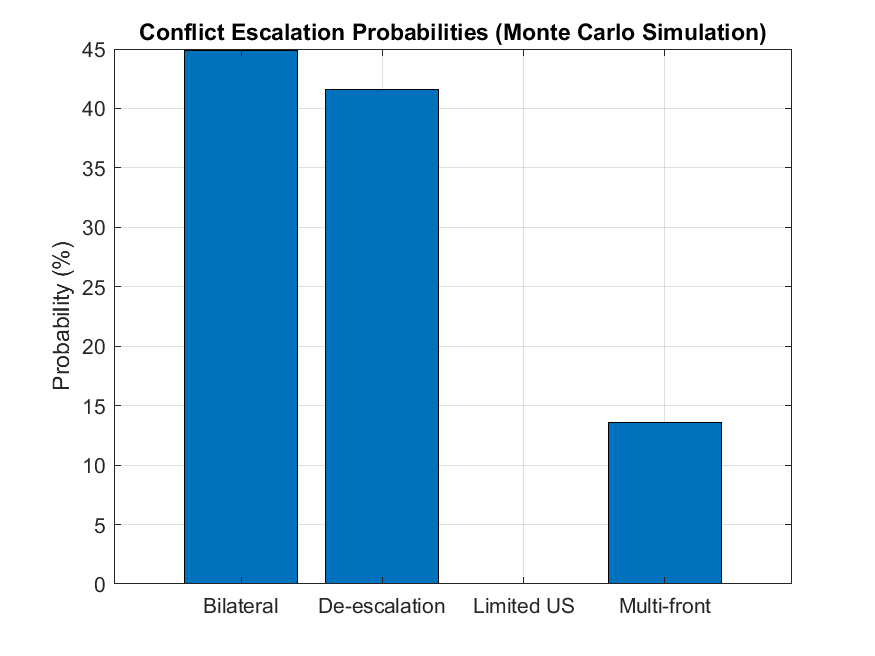
- Multi-front conflict involving Israel, Iran, and the U.S.: 13.55%
- Bilateral conflict between Israel and Iran only: 44.89%
- Limited U.S. conflict (U.S. involvement without broad escalation): 0%
- De-escalation or reduction of tensions without major conflict: 41.56%
Explanation:
The results suggest that after the critical events of June 2025, the most probable scenarios are either a bilateral conflict between Israel and Iran without U.S. direct involvement or a de-escalation scenario where tensions subside. The probability of the conflict escalating into a multi-front war including U.S. forces is less than 14%, while the model found no likelihood for limited U.S. involvement without significant escalation.
Recommendations and Next Steps:
- Expand scenario parameters by incorporating diplomatic interventions or economic sanctions to analyze their effects on escalation probabilities.
- Conduct sensitivity analysis on key variables, such as U.S. intervention probability and Israeli defense effectiveness, to understand their impact on overall risk.
- Compare these Monte Carlo results to historical data from similar conflicts to validate model assumptions and improve realism.
Sources and Methodology Explanation:
- The simulation used verified data on military capabilities from open-source databases and news reports on June 2025 military actions by Israel, Iran, and the U.S.
- Monte Carlo simulation methodology was employed to model stochastic conflict dynamics, using thousands of random samples to estimate the probability distributions of different conflict outcomes.
- The conflict and escalation factors were encoded into the simulation as probabilistic variables, such as the intensity of Iranian retaliation modeled via a Poisson distribution and U.S. intervention threshold probabilities.
- The resulting probabilities and bar chart visualization represent aggregated outcomes from 10,000 simulated conflict trajectories.