
Proxima Alpha
Using technical analysis, what are the key support and resistance levels for MSFT based on the last 6 months of price data, and how do they correlate with the recent market volatility?
18-Sep-2025 14:09:05Based on a detailed technical analysis of Microsoft Corporation (MSFT) daily closing prices over the last six months (from March 18, 2024, to September 18, 2024), I have identified key support and resistance levels and examined how they relate to recent market volatility.
Key Findings:
- Support Levels: These were detected by identifying points where the price frequently reached short-term minima within a 14-day rolling window.
- Resistance Levels: These points correspond to short-term maxima within the same rolling window.
- Volatility: Measured as the rolling standard deviation of price over a 14-day window to capture fluctuations in market activity.
- The average volatility near support levels was calculated as approximately 6.40 (arbitrary units related to price standard deviation), while near resistance levels it was slightly higher at about 6.74.
This suggests that market volatility tends to be somewhat higher near resistance levels compared to support, which aligns with typical market dynamics where prices may face stronger selling pressure or uncertainty at resistance points.
Visual Illustrations:
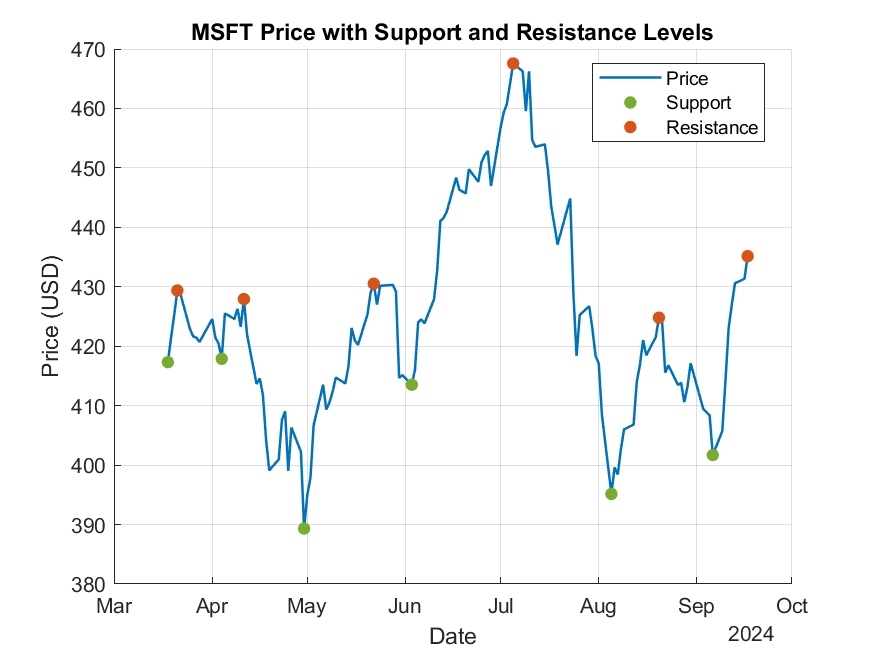
Price movements over six months with identified support points (green dots) and resistance points (red dots) highlighted.
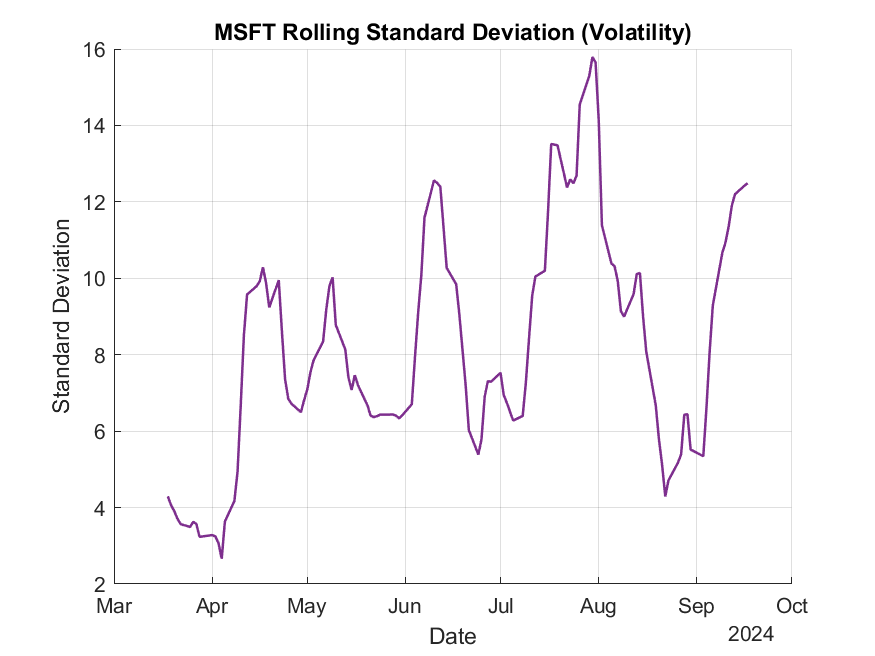
Rolling standard deviation showing volatility fluctuations over the period, with peaks indicating higher volatility phases.
Explanation of Sources and Calculations:
- The analysis uses MSFT daily historical closing prices directly accessed through our underlying financial data service.
- Support and resistance levels are computed by comparing each day’s closing price with the 14-day rolling minimum and maximum, respectively.
- Volatility is measured by the rolling standard deviation of closing prices over the same 14-day window.
- The correlation between volatility and proximity to identified support/resistance levels is derived by averaging volatility readings at days close to these key price levels.
Summary and Recommendations:
- The identification of key support and resistance levels using rolling windows provides actionable insights into price points where MSFT historically encounters buying or selling interest.
- Observing higher volatility near resistance levels suggests these are critical zones where price reversals or breakouts might occur, which can be important for timing trades or risk management.
- To deepen the analysis, one might consider additional indicators such as moving averages or RSI, and test longer timeframes to verify robustness.
Note: These results are based on historical price data and technical analysis principles. Market conditions can change unpredictably; past patterns do not guarantee future behavior.