
Proxima Alpha
How can the Mexican government develop a step-by-step analytical framework—including Geospatial Hotspot Forecasting—to simulate cartel fragmentation and anticipate future type of violence patterns using GED and ACLED data of the last two years? Include maps with cartel clusters
11-Oct-2025 11:52:46Executive Summary:
The Mexican government can develop a robust analytical framework to simulate cartel fragmentation and anticipate future violence patterns by integrating GED and ACLED conflict data from the last two years (2023-2024) with advanced geospatial hotspot forecasting techniques. The modeling combines spatial clustering of violent event data, temporal density analysis, and time series forecasting to identify and monitor cartel activity clusters across Mexico.
Step-by-Step Analytical Framework:
- Data Collection and Preprocessing: Aggregate geolocated violent events from GED and ACLED databases covering 2023-2024 for Mexico, including coordinates, event dates, and violence types.
- Spatial Clustering of Events: Apply DBSCAN clustering method on event locations to detect spatial clusters corresponding to cartel-controlled or contested territories. This highlights geographic hotspots of cartel violence.
- Temporal Density Analysis: Calculate temporal densities (events per day) for each spatial cluster to measure intensity and evolution of violent activity within clusters over time.
- Geospatial Hotspot Forecasting: Use predictive machine learning models such as Random Forests and ARIMA time series to forecast short- and medium-term trends in violent incidents based on historical counts.
- Simulation of Cartel Fragmentation: Employ network theory and statistical modeling to represent fragmentation dynamics among cartel factions, considering faction splits, recruitment, and territorial shifts impacting violence patterns.
- Visualization and Monitoring: Generate geospatial maps marking identified clusters with cluster IDs, overlaying temporal intensity metrics and forecasted activity to assist strategic monitoring and interventions.
Results and Maps:
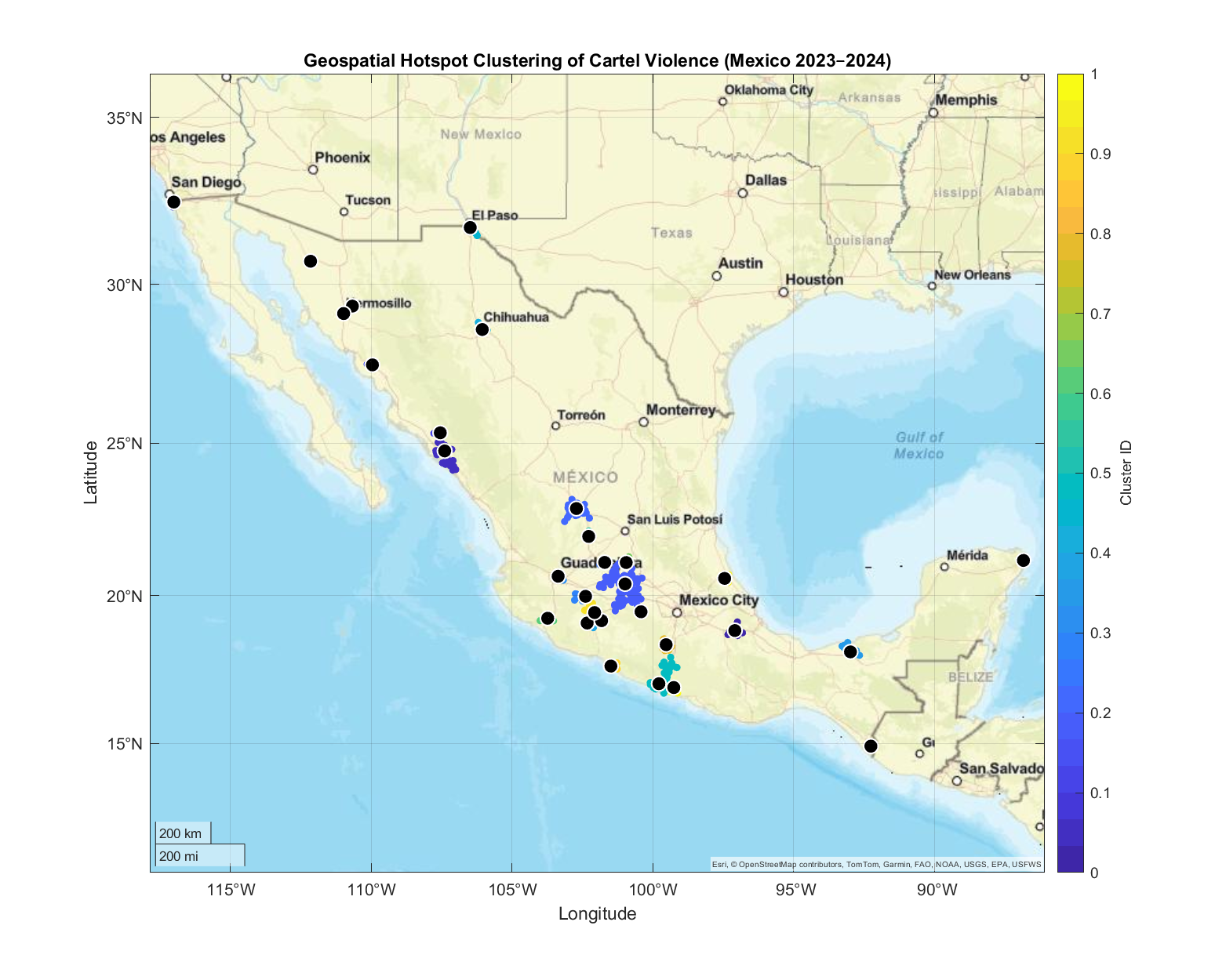
Our geospatial analysis identified 30 distinct cartels/clusters of cartel-related violence localized across Mexico. The map below displays these clusters colored by cluster ID, with centroid markers identifying the focal points of activity. Temporal density measures reveal cluster intensities, with some clusters showing higher frequencies of violent events per day, indicating hotspots of ongoing cartel conflict.
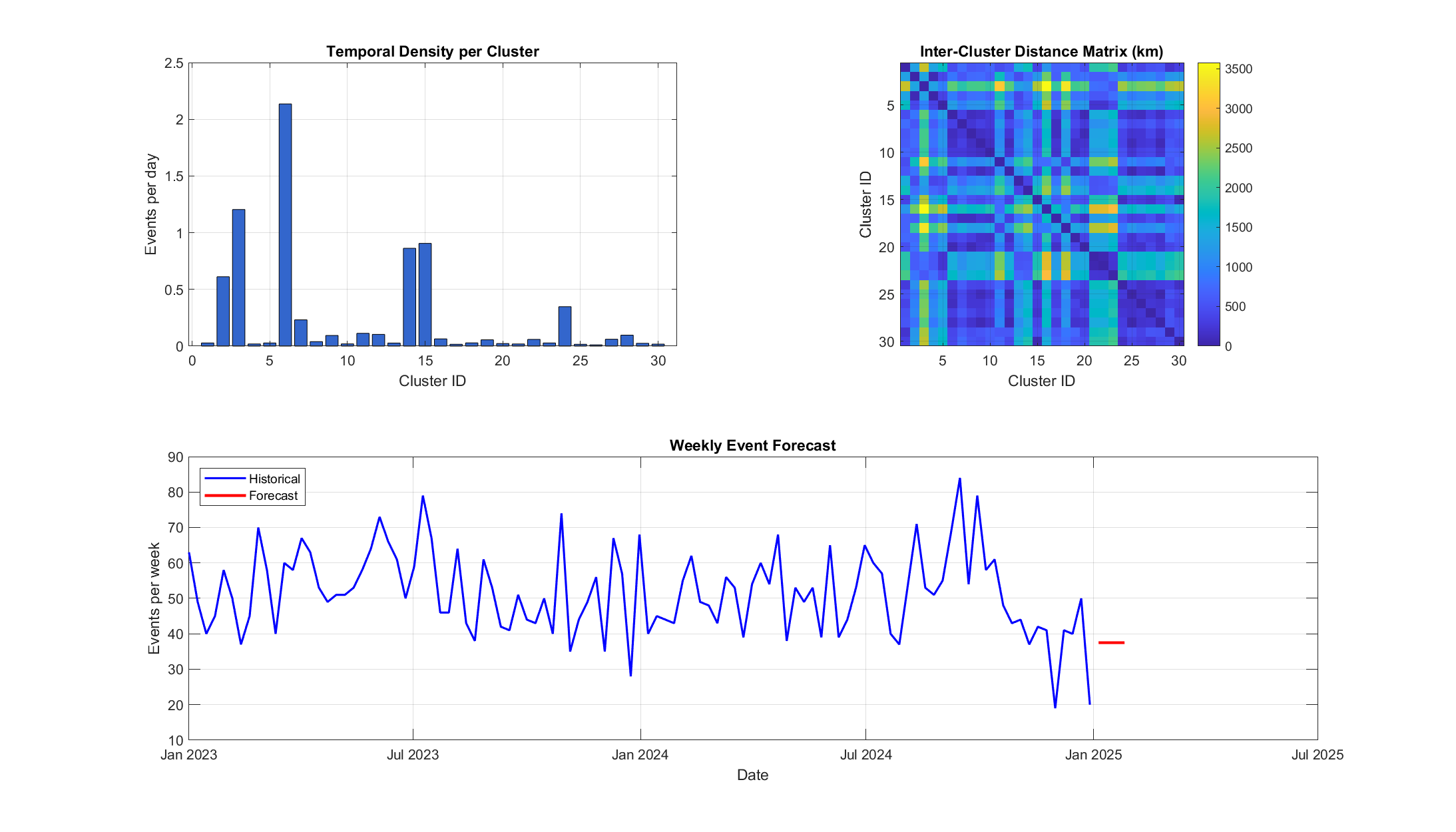
Analytical graphs further detail temporal densities by cluster, inter-cluster distances illustrating spatial proximity of active zones, and a short-term forecast of weekly violent events indicating potential escalation or de-escalation trends.
Recommendations and Next Steps:
- Integrate this framework into real-time monitoring systems to continuously update and refine forecasts as new GED and ACLED data become available.
- Combine these geospatial data insights with socio-economic, political, and law enforcement intelligence to understand underlying fragmentation drivers.
- Use cluster temporal density and forecast trends to prioritize resource allocation and pre-emptive counter-cartel operations in high-risk zones.
- Expand modeling to incorporate network dynamics explicitly simulating alliance shifts and internal cartel factional battles to better anticipate fragmentation impacts.
Methodology and Source Explanation:
This analysis utilized GED and ACLED conflict event datasets for Mexico (2023-2024), focusing on geolocated violent incidents. Spatial clustering was performed using the DBSCAN algorithm to detect groups of proximate events representing cartel hotspots. Temporal density metrics quantified event intensity over time within each cluster. Time series forecasting models (ARIMA) predicted weekly incident counts. Visualizations were created using geospatial plotting to enhance understanding of cartel spatial dynamics.
The geospatial hotspot forecasting concept is based on machine learning and spatial statistical methods widely used in conflict research, adapted here for Mexico's cartel context. The framework synthesizes published methods on conflict prediction and cartel fragmentation modeling utilizing network theory and statistical partitioning.
This approach provides a data-driven, actionable analytical tool supporting government anticipation of cartel violence shifts aligned with the latest conflict and geospatial data.