
Proxima Alpha
Can you apply the residual income model to Microsoft, forecasting book value and ROE over 5 years, calculating residual income, and deriving the justified price-to-book ratio, then compare it with the actual P/B ratio to assess valuation?
17-Sep-2025 08:45:58The residual income model has been applied to Microsoft (ticker MSFT) using the latest financial data. Here's a summary and explanation of the results:
Step 1: Data and Assumptions
- Current book value per share (BVPS): $46.2
- Current return on equity (ROE): 32.44%
- Cost of equity assumed: 8%
- Shares outstanding: 7.43 billion
- Growth rate for book value and ROE forecasted at 5% annually over 5 years
Step 2: Forecast and Calculation
- Book value per share and ROE were projected to grow at 5% annually for 5 years.
- Residual income was calculated each year as (ROE - cost of equity) × book value.
- The present value of these residual incomes was computed using the cost of equity as the discount rate.
- From these, the justified price-to-book (P/B) ratio was derived as 1 plus the present value of residual income divided by the current book value.
Results:
| Justified P/B ratio | 2.215 |
| Current Market P/B ratio | 11.018 |
| Valuation Difference (Justified - Market) | -8.803 |
Interpretation:
- The intrinsic justified P/B ratio of approximately 2.215 suggests the fair value of Microsoft stock relative to its book value based on forecasted residual income.
- The current market P/B ratio is much higher at around 11.018, indicating the market is pricing in significantly higher growth, intangible assets, or expectations beyond what the residual income model projects.
- The large difference (-8.803) signals a potential overvaluation by the market compared to the residual income intrinsic valuation.
Visual Summary:
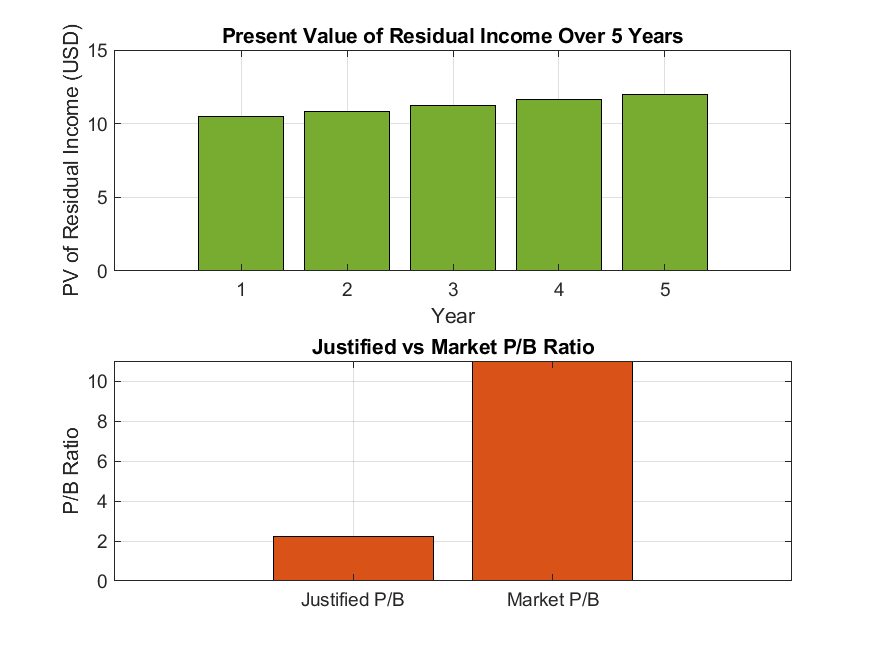
The bar charts above display the present value of residual income over the five-year forecast and the comparison between the justified and market P/B ratios, clearly illustrating the valuation gap.
Recommendations and Next Steps:
- Conduct sensitivity analysis on assumptions such as growth rate and cost of equity to understand their impact on the justified P/B ratio.
- Investigate market factors or qualitative elements driving the high market P/B, such as intangibles, brand value, or future prospects not captured fully by the residual income model.
- Complement this analysis with other valuation models like discounted cash flow or comparables for a more comprehensive picture.
All the data used here was retrieved from Microsoft’s latest financial statements and market data as of mid-2025. The residual income model applies standard valuation theory to forecast and discount residual earnings relative to the book value.
If you want, I can provide more detailed breakdowns or adjust assumptions and rerun the calculations.